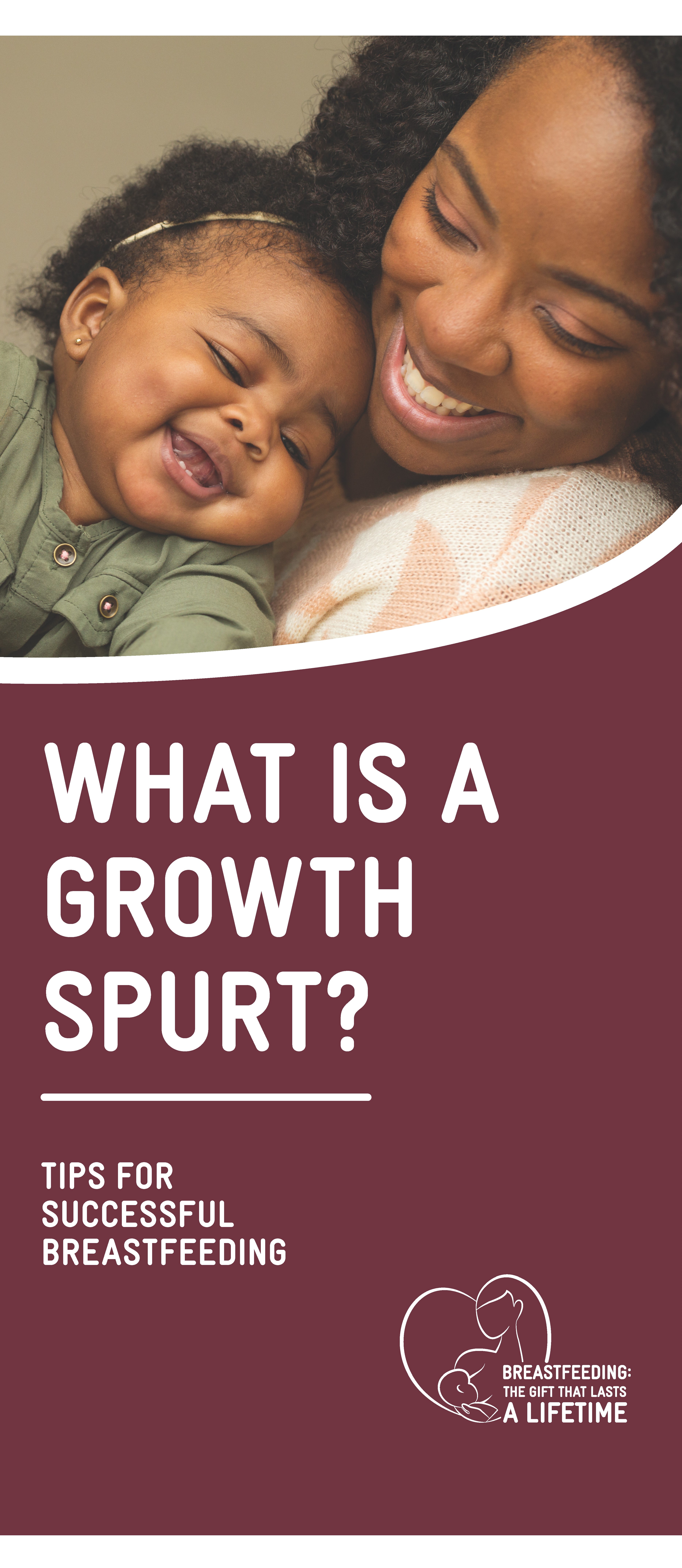
What Is a Growth Spurt?
Growth spurts are times your baby
grows very fast. This is normal.
During growth spurts, babies need
more calories. For breastfed babies, this
means nursing more often to meet the baby’s
nutritional needs. If baby pulls off the breast
and still acts hungry, start the feeding again.
Growth spurts last for 1 to 2 days for
most babies.
How to tell baby may be
having a growth spurt
- Baby nurses more often and
stays at the breast longer.
- Baby seems extra fussy or cries
more often than usual.
- Baby pushes or pulls at your breast or
acts very restless while nursing.
- Baby is at an age when growth spurts occur.
Ages when growth spurts occur
The first growth spurt occurs about 2
to 3 weeks after the baby is born.
Other growth spurts may occur at about:
- 6 weeks
- 3 months
- 6 months
Growth spurt tips
Feed when baby seems hungry
- Nurse when baby shows hunger cues,
even if more often than usual.
- If baby pulls off the breast and still acts
hungry, resume feeding on the other breast.
- Hang in there! After 1 to 2 days, baby should
go back to the previous feeding schedule.
How to tell if baby is getting
enough breastmilk
- Baby should have at least 6 wet diapers a day.
- Baby should have at least 3 dirty diapers a day.
- Baby should gain 4 to 7 ounces per week.
After about 4 to 6 weeks, a baby who only drinks
breastmilk may have fewer soiled diapers. Some
babies may not have a bowel movement every day.
Understanding growth spurts
During the first growth spurt, many nursing
parents worry that they are losing their milk
supply and their babies are not getting enough
milk. The parent's breasts may become smaller
and softer at this time. The reason is less
swelling in the breast, not less milk. The nursing
parent’s breasts are never empty; they are
always making milk for the baby. During growth
spurts, it may seem like the baby is nursing
all the time. This is normal—hang in there. In
a day or two, baby will be less demanding.
Some growth spurts even go unnoticed. If the baby
seems extra fussy or is nursing more than before
and you suspect a growth spurt, nurse the baby.
You cannot spoil the baby by holding them and
offering the breast more frequently. Nursing more
often will cause your body to make more milk. It
will build up your milk supply to meet the baby’s
needs. Giving a bottle or pacifier will not help. It
will cause you to make less milk. It cuts down on
the amount you breastfeed, making your body think
you need less milk, so less milk will be produced.