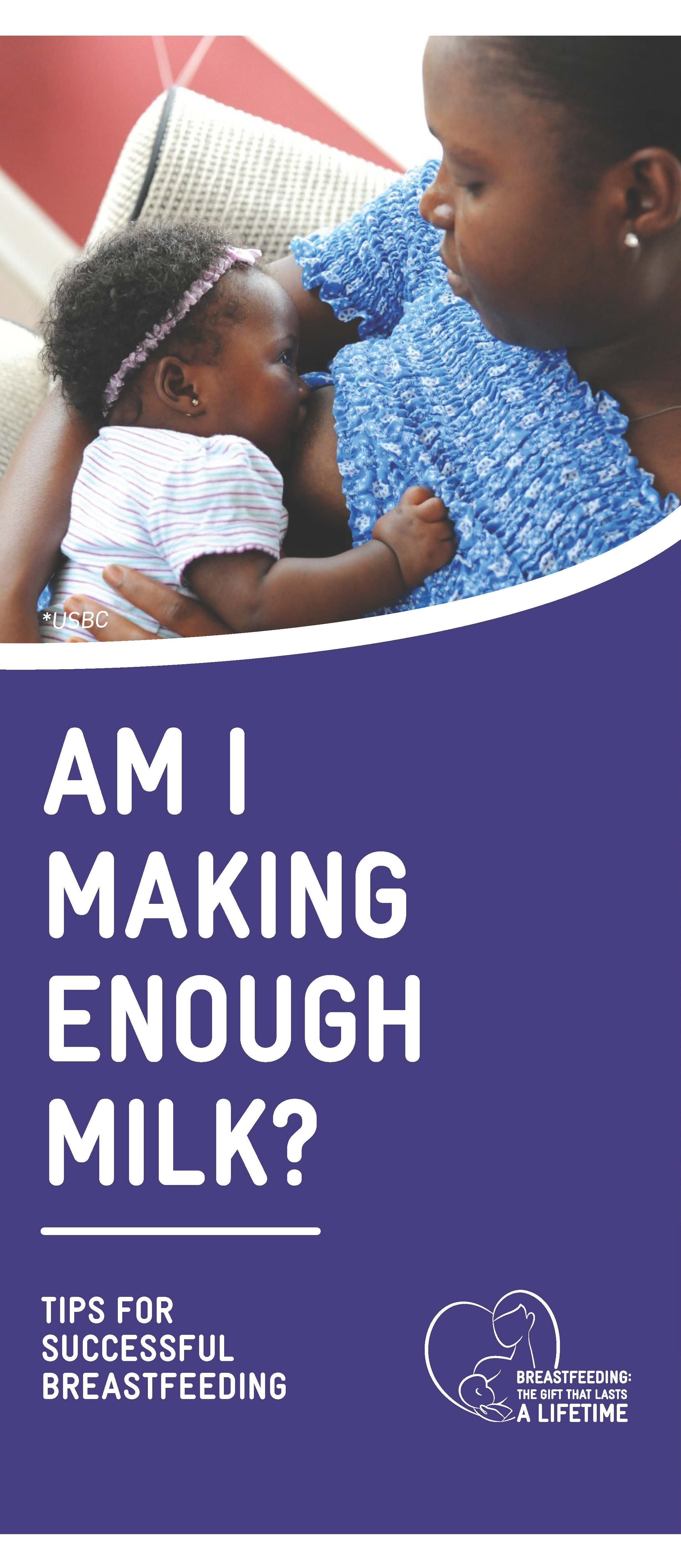
Am I Making Enough Milk?
The more you breastfeed, the more milk
you will make. Feed often, at least 8
times in 24 hours, especially when
your baby is less than a month old.
Making enough milk
Check for good latch-on and positioning
Your baby should take your breast, about 1 to
1½ inches beyond the nipple, into their mouth.
Hold your baby snugly against you. Their chin
should be touching your breast, and their nose
will be touching or very close to your breast.
Nurse Often
For the first 2 to 3 months, your baby may
not feed at the exact same times. Be sure
he or she feeds 8 to 12 times during the day
and night (usually every 1½ to 3 hours).
Massage your breasts
Gently stroke your breasts, away from the
nipple, right before and while nursing to help
you relax, get your let-down (release of milk
from the breast), and make more milk.
Take care of yourself!
Make time to eat. When busy, have healthy snacks
and quick meals. Drink water and nutritious
liquids, like 100% juice or low-fat milk, to
quench your thirst. Rest when your baby sleeps.
Ask others to help with household chores.
If you smoke, try to quit
Smoking can decrease your milk supply. If you are unable to quit, try to cut down on smoking as much as possible.
Avoid supplements
For the first 3 to 4 weeks of your baby’s life, avoid using formula and never give baby food or water to babies this young. These can fill your baby up, causing them to drink less from your breasts. Breastmilk has lots of water to meet your baby’s fluid needs. Both early breastmilk (colostrum) and mature breastmilk provide all the nutrition needed for your baby.
Avoid using bottle nipples
Babies use different tongue and jaw motions to suck on pacifiers and bottle nipples compared to how they suck to get milk from the breast. When these are used before a baby is 3 to 4 weeks old, they may confuse the baby.
Medications may affect your milk supply
Most medicine is safe while breastfeeding, but some can affect milk supply. Talk to a breastfeeding specialist or your doctor if you are taking any medication.
To build up an established milk supply
Nurse or pump often
Nurse (or pump) at least 8 times in 24 hours. If already doing so, nurse or pump more often – up to 12 times throughout the day and night. If your sleeping baby has not fed in 4 hours, wake them to feed.
Nurse long enough
How long a baby nurses will vary. Some babies nurse for as little as 10 minutes while others can take 30 minutes or more. Be sure to let your baby decide when to end the feeding. This lets them get the milk that is higher in fat and calories which comes later in the feeding.
Nurse on both breasts
If your baby is not taking milk from both breasts at each feeding, nurse on one side and pump or hand express on the other.
Reach out for help
- Call WIC if you are using a nipple shield to check that it is not causing your low milk supply.
- Call WIC, your breastfeeding specialist, or your healthcare provider if you think your baby is not getting enough or not growing well.
How to tell your baby is getting enough
By the time baby is 6 days old and your mature milk has come in
- Baby gains weight. Babies will lose a small amount of weight before starting to gain and that is normal, yet they should be back to birthweight by 2 weeks old.
- Baby has at least 6 wet diapers in 24 hours.
- Baby has at least 3 bowel movements a day.
It is normal for babies older than 4 to 6 weeks of age to have anywhere from many bowel movements a day to 1 bowel movement a week.