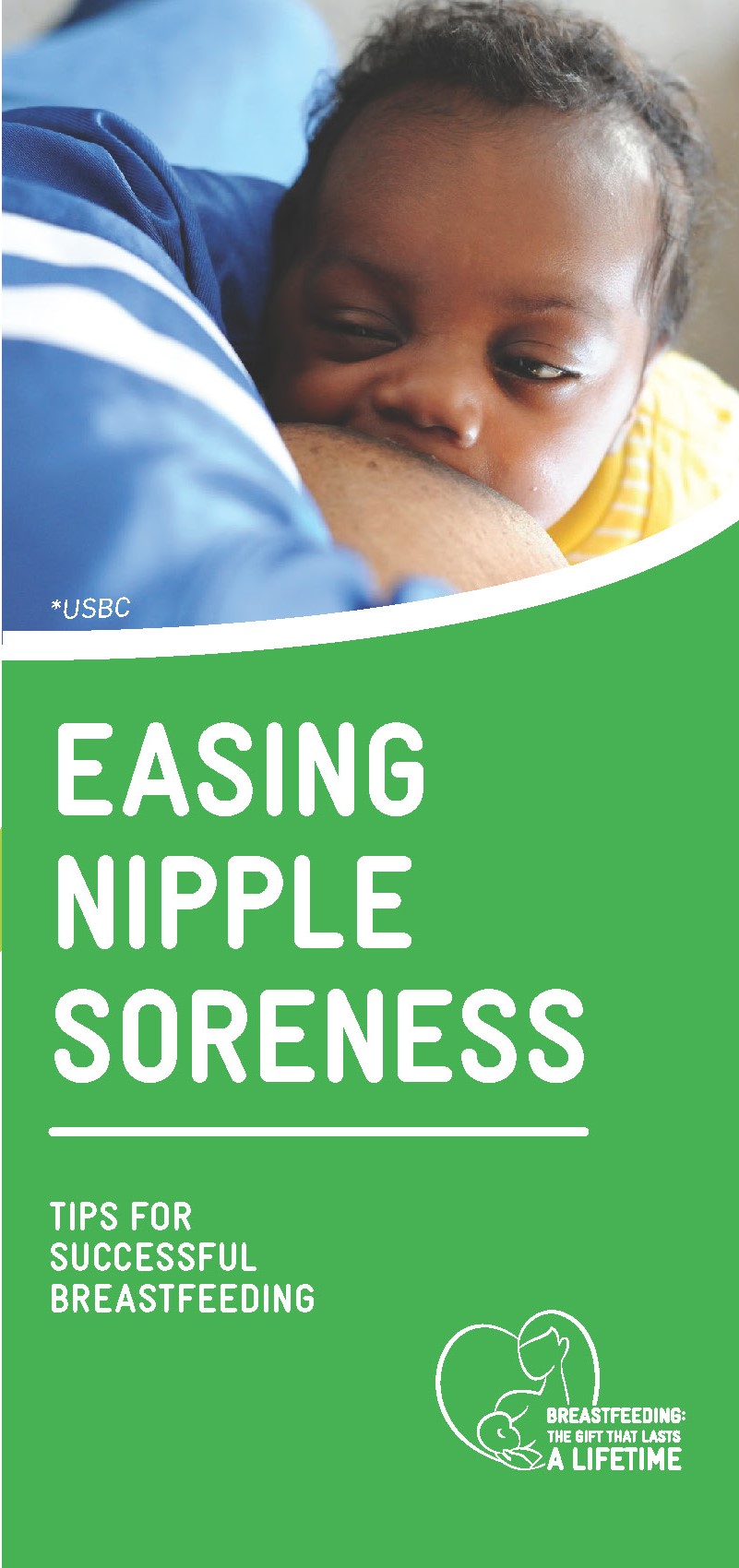
Easing Nipple Soreness
Breastfeeding is not supposed to hurt. Some
people may feel very slight soreness when
babies, less than 2 weeks old, latch onto
the breast. This is normal — don’t give up! This
feeling eases within the first 45 to 60 seconds of
nursing. When a baby is about 3 to 5 days old, the
soreness may become more intense. It is okay
to ask for help at this time. The discomfort or
tenderness should stop by the time baby is 10
days old. By the end of baby’s second week of
life most people do not have nipple soreness.
When to contact a breastfeeding specialist for extra help
- Your nipples are cracked or bleeding.
- There are blisters on your nipples.
- You still feel sore after the baby is
2 weeks old.
- The soreness lasts the whole feeding.
- The soreness begins after your baby is
2 weeks old.
Tips to prevent or relieve sore nipples and increase comfort
Check that you and your baby are positioned well
Having your baby positioned the right way is
one of the most important ways to prevent
nipple soreness. Your baby should be facing
your breast and not turning their head. Their
ear, shoulder, and hip should all be in a straight
line. Baby’s tummy should be facing your body.
Check to see that baby has a deep latch
You should notice that a large portion of your
areola, the dark area around your nipple, is in
your baby’s mouth (about 1 to 1 1/2 inches back
from the tip of the nipple). Your baby’s lips should
form a seal around your breast and should be
turned out. Baby should be in close, with chin
and cheek touching your breast and nose either just touching or very close to your breast.
Breastfeed often
Nurse your baby at least 8 to 12 times during the
day and night usually every 2 to 3 hours. Be sure to
nurse long enough to soften and empty the breast.
Notice early signs of hunger
Offer the breast when baby shows early hunger
signs, such as when they open their mouth wide
or put one or both fists in their mouth. This
will allow you to nurse before your baby gets
so hungry that they are upset. A calm baby
is more likely to latch on and nurse well.
Nurse on the less sore breast first
Your baby’s suck is often strongest at the
start of the feeding. When you switch to
the more sore breast, your baby’s suck
will most likely feel more comfortable.
Try different feeding positions
Lean back and get comfortable. Vary between
football hold, cradle hold, and laid back
nursing. This will change the place on your
breast where baby’s suck is strongest.
Remove a small amount of milk
Try to hand express or pump a little milk
to soften the breast tissue if it is hard for
your baby to latch onto your breast.
Break suction before taking your baby off the breast
If your baby has not released suction,
gently put your finger in the corner of your
baby’s mouth, between their gums.
Express your milk if you are too sore to nurse
If you feel too uncomfortable to put baby to
breast, hand express or use a pump to remove
milk often. Save the milk that you collect to use
at a time when baby is not feeding at breast.
Tips for treating sore nipples
Use breastmilk to help heal your nipples
Express a little milk after your baby is done
feeding. Gently rub it on your nipples and allow
to dry. This protects and heals your skin.
Use purified lanolin to ease soreness and promote healing
Apply a thin coat of purified lanolin (such
as Lansinoh or Tender Care Lanolin) to the
nipple after each nursing. This does not need
to be washed off before the next feeding.
Avoid soaps and body creams
Soaps can dry your nipples and get in the way of your body's natural lubricant.
If you use nursing pads, change them often
If your milk leaks between feedings, nursing
pads can improve your comfort and help
keep your nipples dry. Change the pads each
time they become damp so your nipples
do not get chapped and more sore.