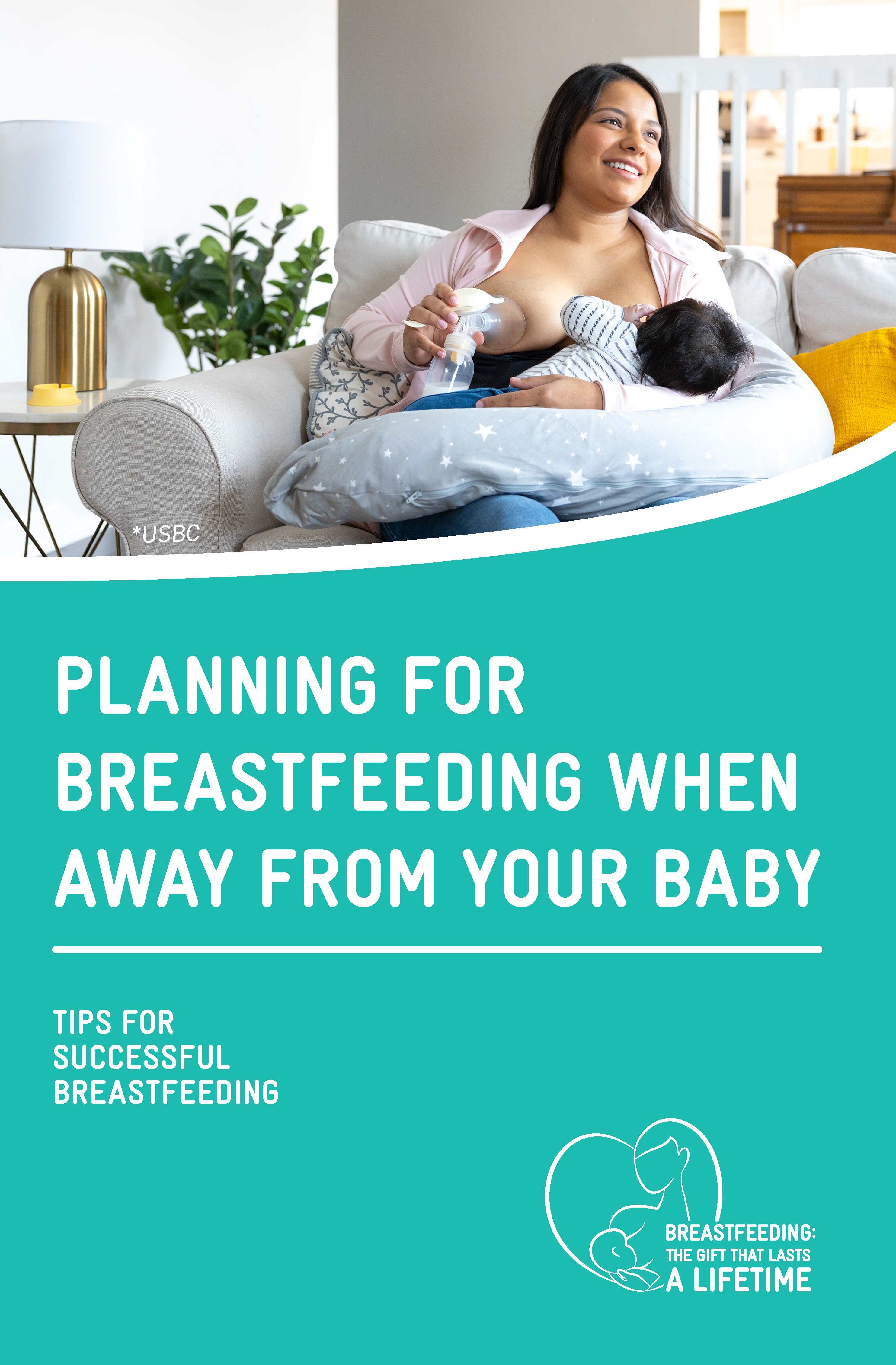
Planning for Breastfeeding When Away From Your Baby
You can continue to breastfeed when you return to work
or school. You will give your baby the special gift of
your milk, even when apart. This will help you keep
the close bond with your baby and your baby will still get
the many advantages of breastmilk. Be creative! Here are
some ideas. One of these options may work well for you.
- Find a sitter who is close to where you work or attend
school. Then you may be able to go to your baby or
have baby brought to you when it is time to nurse.
- Work or attend school from home (virtually) so you
can be with your baby to nurse when needed.
- Nurse when you are with your baby. Pump your milk
while you and your baby are apart. Safely store the milk
for your sitter to use the next work or school day.
- Nurse when you are with your baby. If leaving breastmilk
is not an option, have the sitter give formula while
you are apart. You may need to express a little milk
during the day for comfort in the early weeks.
Be sure to contact WIC if you are not pumping the amount of
breastmilk your baby is eating while you are at work or school.
WIC can give you tips to help you pump more breastmilk.
Timetable before leaving baby with someone else
10 - 14 days ahead of time
Try pumping. You may only get one ounce or less of
breastmilk at first – that is normal. Safely store the milk
you collect to use at another time. Some tips:
- Pump at the times that you plan to be away from your baby.
- Many people who pump find that they get more
milk during morning pumping sessions.
- Some people find it works well to pump after a feeding.
- Other people choose to nurse on one side
and pump on the other side.
- Start giving your baby one bottle feeding a day. It is best for
baby to be at least one month old. Choose a feeding time when
you will be at work or school. Your baby may take the bottle
better if given by someone other than yourself. It also may
help if you are not in the room while the baby is being fed.
- While someone else is feeding your baby, pump more
milk if you will be pumping when away. This will help you
keep a good milk supply and get your body used to what
you will be doing once you return to work or school.
- Nurse or pump in different places, like a friend’s
house. This may help you adjust to nursing at the
sitter’s or pumping at work or school.
- If you are pumping while the baby is not with you, look at your
baby’s picture or listen to your baby’s sounds as you start
pumping. Many parents store these on their cell phones.
- Think about where you might pump at work or school. Ask your
boss for help finding a clean, private place for you to use.
- Think about clothes that will make it easy to nurse or
pump. Tops that open in the front and two-piece outfits,
such as a shirt and skirt or pants work best.
7 - 10 days ahead of time
- Leave your baby with a sitter for a short period of time. Be sure to leave milk for the sitter to feed the baby.
- If you are not using pumped breastmilk while apart:
- Stop breastfeeding during one of the times you will be away. Feed baby formula instead for that feeding.
- After a few days, replace another nursing time with formula, until you are nursing only when you and your baby will be together.
The day before
- Write down the times you most often feed the baby and ask the sitter to feed at these times if the baby seems hungry.
- Pack the diaper bag, your lunch, healthys nacks for work, your pump and a place to safely store your pumped milk for transport.
Storing breastmilk
Note: Breastmilk may look thin and bluish. Each time you
pump, it may not always look the same. After a while, it may
separate into layers in the bottle. All of this is normal.
- Store your milk in clean, hard plastic or glass bottles,
or disposable breastmilk storage bags.
- Put enough milk for one feeding in each storage bag
or bottle. Leave some space at the top if you plan to
freeze the milk because it will expand when frozen.
- Chill freshly pumped milk before adding it to chilled or frozen milk.
- Label each bag or bottle with the date.
- Your milk can be kept up to 4 days in the refrigerator and 6
months in the freezer. Place breastmilk in the back of the
refrigerator or freezer. Put newly pumped milk toward the back
of the supply and move older milk to the front to be used first.
- If you are at work or school and do not have a refrigerator,
store your pumped milk in a cooler with ice packs.
Thawing/warming
Thaw frozen breastmilk by:
- Putting the frozen milk in the refrigerator the night before.
- Setting the sealed bottle or bag in a bowl of warm water for 15-20 minutes.
- Holding the sealed bottle or bag under warm, running water. Gently mix.
Once thawed, breastmilk should be used within 24 hours, and if not used, it should be thrown out.
Never use a microwave or heat on the stove. The high heat can harm the breastmilk. MIcrowaves can cause hot spots that could burn your baby.
Talking with your boss
Let your boss know that you plan to pump your milk when you return
to your job. It is best to talk to your boss at least two weeks before
you start back at work, so there is time to find a private place for you
to pump. If you have talked about this with your boss while you were
pregnant, talk to your boss again to be sure everything is set for you.
You may be the first person to ask this at your workplace, so they
may need to learn about how to support your pumping breastmilk
in the work setting. Let your boss know that you will need:
- A private place (not the bathroom) with an electrical outlet. This space does not need to be large. It can even be used fro other things when you are not pumping.
- Two to three, 20-minute breaks to express milk and clean your pump parts afterwards.
You will need to discuss how your breaks will be handled. While
the law requires that employers give you time to express milk, it
does not require they pay you for that time unless you are working
or using a paid break while pumping. Some options are:
- Your boss agrees to pay you for your pumping break time.
- You can come to work early and stay late
to make up for extra break time.
- You do work while you are pumping and, as
a result, are paid for that time.
- You use lunch and other paid break times to express
milk so you do not need to make up any time.
- You choose not to make up the time taken for pumping
milk and are paid for a shorter workday.
Be sure to thank your boss for supporting breastfeeding.
Also use these ideas when talking to someone in charge at your school.
Facts your boss will want to know
The laws (Affordable Care Act, H.R. 3590 and PUMP for
Nursing Mothers Act, S. 1658/H.R. 3110) require that, in most
cases, employers provide employees (unpaid) time to pump,
and a private, non-bathroom place to do so until their babies
are 1 year old. Pumping at work benefits employers.
- Parents of breastfed babies are less likely to miss work to
care for a sick baby because breastfed babies are healthier.
- Employer healthcare costs are lower since both parent and
baby are less likely to get sick and need to go to the doctor.
- Parents who pump at work are happier, more productive employees.
- Businesses that give those working for them time to
express milk have found they save money as a result.
- Employers have lower staff turnover rates.
- Employers have higher staff loyalty.
- Many companies find that
breastfeeding support in the
workplace improves overall
company image and helps
attract top-notch staff.
- Breastfeeding
support in the
workplace gives a
positive return on
investment (ROI).
Tips for the sitter
Thank you for being there for this parent! These tips can help you support their desire to continue to provide breastmilk.
- Breastfed babies should be held close while feeding.
They often feed slowly and may take less milk
than those who are not breastfed. This is okay.
- Hold baby upright and feed using baby-paced
bottle feeding. This way of holding the bottle allows
the baby to control how much baby drinks.
- Breastmilk looks thin and often bluish-white. Each
bottle of milk may look different. The milk may separate
into layers in the bottle. Gently mix before feeding.
- Try not to feed the breastfed baby right before
the nursing parent is expected to pick baby up.
- Provide a comfortable place to nurse the baby
if desired during drop off and pick up times.
Storing breastmilk
- Breastmilk can be stored in a standard
refrigerator, along with other foods.
- Store breastmilk toward the back of
your refrigerator or freezer.
- Freshly pumped milk should be refrigerated
and used within 4 days. Use or discard
thawed breastmilk within 24 hours.
- Keep a small amount of breastmilk labeled with
the date of pumping in your freezer in case extra is
needed. Use within 6 months of the labeled date.
Warming breastmilk
Warm or thaw breastmilk by placing the sealed bottle
in a bowl of warm water or holding it under warm,
running water. Never use a microwave or heat it on
the stove. High heat can harm breastmilk. Microwaves
can cause hot spots that could burn the baby