Updated September 10, 2026
Vaccines are an important and effective way to protect against severe illness and keep communities safe. Under Maryland law (Health-General §18-112, or “The Vax Act"), the Maryland Secretary of Health shall recommend immunizations, screenings, and preventive services for the State, as of July 1, 2026. These recommended vaccinations are required to be covered with no out-of-pocket costs by certain regulated insurance plans. The vaccines are recommended by the nation's leading medical groups, including the American Academy of Pediatrics (AAP), the American Academy of Family Physicians (AAFP), and the American College of Obstetricians and Gynecologists (ACOG), as well as experts at the Maryland Department of Health (MDH). If you have questions about any vaccine, talk to your healthcare provider.
Information below relates to vaccines for the most common seasonal respiratory viruses: COVID-19, influenza (flu) and Respiratory Syncytial Virus Infection (RSV).
More Resources:
Maryland Combined Respiratory Illness Data Dashboard
Influenza surveillance
RSV surveillance
Maryland Vaccine Recommendations
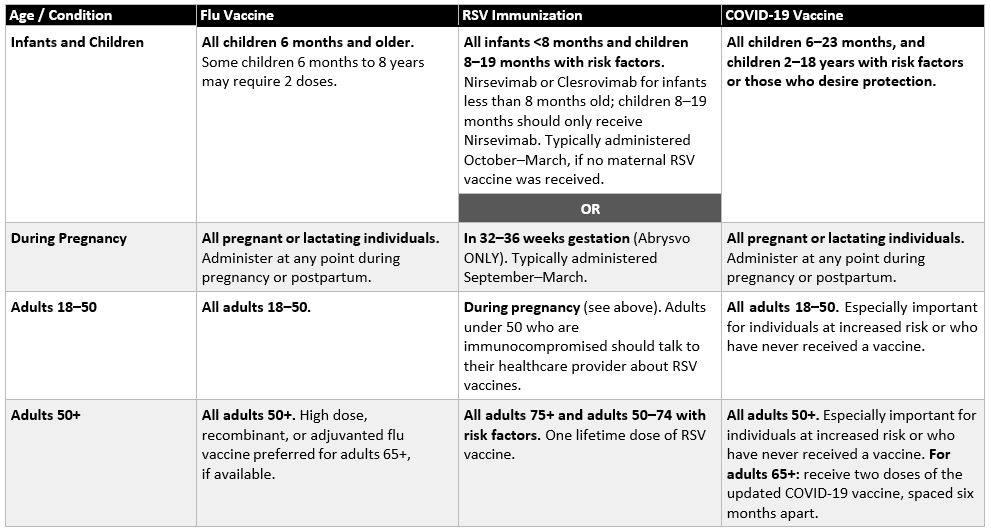
What vaccines are recommended this respiratory virus season?
![]()
Downloadable PDFs, English and Spanish:
How can I best prevent respiratory illness like COVID-19, flu or RSV?
These strategies can help prevent common respiratory viral illnesses:
- Stay up to date with all recommended immunizations.
- Practice good hygiene, including washing your hands frequently with soap and water, and covering coughs and sneezes.
- Take steps for cleaner air, such as gathering outdoors, opening a window, wearing a mask, or improving indoor air quality through HVAC or a portable air filter.
If you have a respiratory virus:
- Stay home and away from others (including people you live with who are not sick). Children should follow guidance from schools.
- You can go back to your normal activities when both are true:
- Your symptoms are getting better overall, and
- You have not had a fever (and are not using fever-reducing medication) for at least 24 hours.
- When you return to normal activities, take added precautions over the next five days, such as practicing good hygiene described above to prevent spread, wearing a well-fitted mask, physical distancing, and/or testing when you will be around others. This is especially important to protect people with higher risk of severe illness from respiratory viruses.
Why is it important to get vaccinated this respiratory season?
Vaccines are one of the best tools we have to help protect against three respiratory viruses that circulate each year: COVID-19, influenza and RSV. These viruses continue to cause significant illness and death in the community. Vaccines help to teach the body's immune system how to recognize and fight the viruses. The Maryland Department of Health encourages all Marylanders to stay up to date on all vaccines recommended for them. To learn more about the impact of COVID-19, flu, and RSV in Maryland (including data on cases, hospitalizations, and deaths), please refer to the Maryland Combination Respiratory Illness Dashboard.
INFLUENZA (FLU) VACCINE
What is the current influenza (flu) vaccine guidance?
Everyone aged 6 months and older should receive the 2026-27 seasonal influenza vaccine, ideally by late October for protection through flu season.
Should kids get the flu vaccine? Should older adults?
Yes, children and older adults are at especially high risk for severe flu illness. These individuals, and those who live and work with them, should be vaccinated . The flu is highly contagious, especially in group settings like schools, and potentially fatal. Adults 65 years and older should preferentially receive a high-dose inactivated, adjuvanted inactivated, or recombinant influenza vaccine when available.
Should I get the flu vaccine every year?
Yes, individuals ages 6 months and older should get a flu vaccine every year. Scientists are continuously updating the flu vaccine to ensure it offers the best protection from new strains of the virus that emerge every year. Studies on effectiveness show that flu vaccination, on average, reduces the risk of serious illness by 40- 60%.
Does private insurance cover the flu vaccine?
Yes, in most cases. Under Maryland's Vax Act, state law requires regulated health plans to cover immunizations, including the flu shot, with no cost sharing. In addition, America's Health Insurance Plans recently announced a commitment by health plans to continue coverage of flu vaccines through 2027.
Does Medicaid cover the flu vaccine?
Medicaid covers all recommended vaccines, including flu vaccines.
RSV VACCINE
What is the current RSV vaccine guidance?
RSV vaccines are recommended for several populations. There are two immunizations recommended to protect infants from severe RSV: a maternal RSV vaccine (Abrysvo) given during pregnancy or an infant RSV antibody (Nirsevimab or Clesrovimab given to infants after birth). Nirsevimab is also recommended to some young children 8-19 months of age who are immunocompromised or at increased risk for severe RSV.
RSV vaccines are recommended for all previously unvaccinated adults ages 75 and older and adults ages 50–74 who are at increased risk for severe RSV (those with certain chronic medical conditions, weakened immune systems, and/or living in long-term care facilities like nursing homes). Adolescents and adults under 50 years who are immunocompromised should talk to their health care provider.
Does private insurance cover the RSV vaccine?
Yes, in most cases. Under Maryland's Vax Act, state law requires that most regulated health plans cover immunizations, including RSV vaccines, and preventive services with no cost sharing. In addition, America's Health Insurance Plans committed to continue to cover RSV vaccines through 2027.
Does Medicaid cover the RSV vaccine?
Yes, Medicaid covers all recommended vaccines, including the RSV vaccine.
COVID-19 VACCINE
Are COVID-19 vaccines safe and effective? Do they have any side effects?
COVID-19 vaccines continue to be an important way to prevent serious illness due to COVID-19. The safety of these vaccines has been well-studied in clinical trials and continues to be monitored through post-marketing surveillance systems. After the COVID-19 vaccination, you may have some side effects. The most common reported side effects include soreness at the injection site, fatigue, headache, muscle aches, joint aches, fever and nausea. They should go away in a few days. Talk with your doctor or healthcare provider for more information.
What are the current recommendations for who should get the COVID-19 vaccine?
Maryland's clinical vaccine guidance for the 202 6-27 respiratory virus season is based on guidance from medical associations including the American Academy of Pediatrics (AAP), American Academy of Family Physicians (AAFP), and the American College of Obstetricians and Gynecologists (ACOG).
Can any Marylander who wants a COVID-19 vaccine get one?
Maryland residents have a variety of ways to obtain vaccines for themselves and their children, and should speak to their health care provider about what is best. The Maryland Department of Health is working closely with our partners to ensure the vaccine is widely accessible across Maryland, including the Maryland Vaccine Program.
Do you need a prescription to get a COVID-19 vaccine?
Marylanders do not need a prescription for a COVID-19 vaccine. Immunizations are available from many providers statewide, including pharmacists who are authorized under Maryland law to give vaccines without a prescription to individuals 3 years and older. Contact your pharmacy or health care provider prior to making an appointment to ask about vaccine availability and requirements.
Does private insurance cover the COVID-19 vaccine?
Yes, in most cases. Under Maryland's Vax Act, state law requires regulated health plans to cover immunizations, including COVID-19 vaccines, with no cost sharing. Maryland is unable to regulate self-funded health insurance plans, Medicare, Medicare Advantage, Tricare, or Veterans Administration benefits under federal law. However, America's Health Insurance Plans recently announced a commitment by health plans to continue coverage of COVID vaccines through 2027.
Does Medicaid cover the COVID-19 vaccine?
Yes. Maryland Medicaid, both the HealthChoice Maryland managed care and fee-for-service programs, covers the COVID-19 vaccine for its participants. As federal vaccine policy changes, the Maryland Department of Health will provide updates about any changes to the way Medicaid customers access vaccines.
Can non-Maryland residents get the COVID-19 vaccine in Maryland?
Residents from outside of Maryland can get vaccinated in Maryland, but the provider may have its own requirements or may not be taking new clients. Contact the provider's office, pharmacy, local health department, or clinic location to ask if you're eligible based on your residency.
How can kids under age 3 get a COVID-19 vaccine?
Maryland recommends the annual updated COVID vaccine for children aged six months and older. Parents and guardians should speak to their pediatrician or health care provider about COVID-19 vaccine availability and the recommendations for their child.
OTHER
What are the current vaccine requirements for school-aged children? Have these changed?
Students in public preschool and K-12 schools remain subject to Vaccine Requirements For Children, by Maryland law, available on the Maryland Department of Health Back-to-School webpage. COVID-19, flu and RSV vaccines are not required for students to attend school, but MDH continues to encourage that children stay up to date on all vaccines recommended for them.
Is vaccination against respiratory viruses (i.e., COVID-19, flu, RSV) recommended during pregnancy?
Yes, all three vaccines are recommended. Maryland's respiratory illness vaccine recommendations during pregnancy align with the American College of Obstetricians and Gynecologists (ACOG), which recommends:
- The updated COVID-19 vaccine at any point during pregnancy, when planning to become pregnant, in the postpartum period, or when lactating;
- the updated influenza vaccine for all individuals who are or will be pregnant during influenza season,as soon as it is available, during any trimester of pregnancy. FluMist (a nasal spray) is NOT recommended during pregnancy; and
- the bivalent RSV PreF (Abrysvo) vaccine for pregnant patients during RSV season to protect their infants after birth.
How is Maryland working with other states/partners to improve vaccine access?
Collaboration with regional and nationwide partners is an important aspect of public health. Maryland participates in the Northeast Public Health Collaborative with other jurisdictions to help protect the public's health, safety and well-being, using information based on science, data, and evidence, and to ensure equitable access to vaccines, medications and services.